Why UFC Africa Event Hasn't Happened Yet
Explore the reasons behind the long-awaited UFC Africa event's delay. This deep investigative look features insights from Dana White, UFC executives, and African sports leaders, along with potential host countries.
Jibril Aminu
2/11/20264 min read
The promise, the politics, the venues, and the quotes that explain why it still hasn’t happened
For nearly a decade, “UFC Africa” has existed in a strange space. It has never been officially scheduled, never officially canceled, yet constantly teased by champions, fans, and even UFC executives.
At different times, the idea has pointed to Nigeria, South Africa, and more recently Senegal, with Rwanda occasionally mentioned in wider venue discussions. What has changed over time is not the desire. It is the business reality required to land the UFC on African soil.
The golden era that made UFC Africa feel inevitable
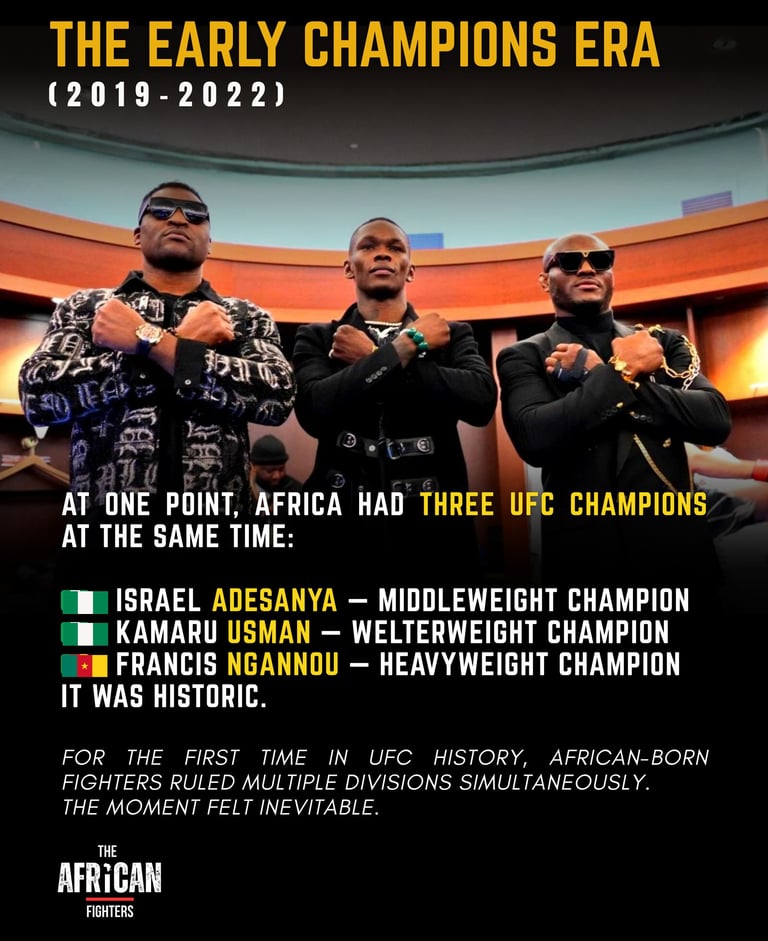
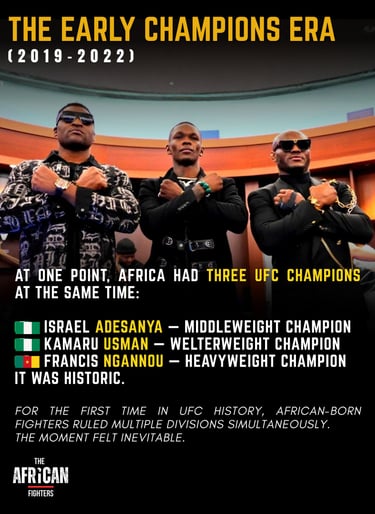
From 2019 to 2022, African MMA reached a historic peak. Israel Adesanya, Kamaru Usman, and Francis Ngannou held UFC titles at the same time, creating an unprecedented moment of African dominance in the sport. That championship run created strong global momentum and intensified calls for a UFC event on the continent.
Israel Adesanya once stated, “It’s already in the works… we’ve been talking about it for a while.”
Reference: ESPN interview prior to the Anderson Silva fight, 2019.
The “three champion” era did more than build excitement. It created a commercial narrative that Africa was ready for a major UFC event.
UFC leadership openly discussed Nigeria as a potential host
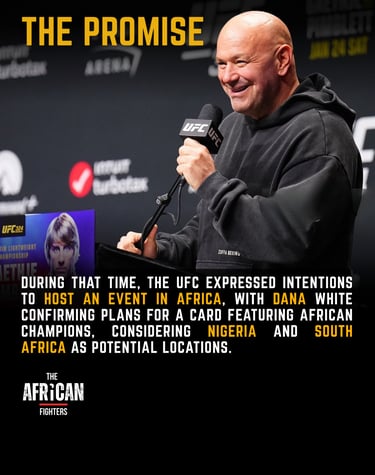
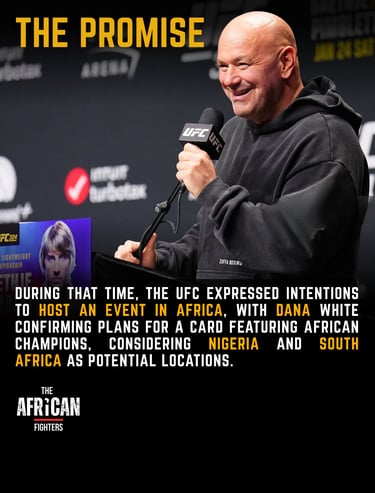
UFC President Dana White repeatedly confirmed the organization’s ambition to bring the promotion to Africa and publicly named Nigeria as a key possibility.
Dana White stated, “Nigeria is what we’re thinking.”
Reference: UFC 281 post-event press conference coverage, CageSide Press.
He also added, “I want to do Africa so bad. That’s sort of my focus.”
Reference: CageSide Press interview coverage, 2022.
Dana White further suggested the long-term commitment the UFC was considering, saying, “I’m going to build a Performance Institute over there.”
Reference: CageSide Press coverage of UFC Africa expansion discussions.
These comments confirmed that Africa was not simply a fan-driven rumor. It was a real expansion objective within UFC leadership discussions.
Infrastructure and broadcast readiness became the biggest obstacles
While fan enthusiasm and athlete representation were strong, UFC executives consistently pointed to infrastructure requirements as the primary challenge. UFC COO Lawrence Epstein explained the organization’s expansion approach clearly.
He stated, “The first thing we look for is an arena that suits our size requirements.”
Reference: BBC Sport Africa interview with UFC COO Lawrence Epstein, 2023.
He also explained, “The challenge has always been the infrastructure and the television broadcast side.”
Reference: BBC Sport Africa reporting on UFC Africa discussions.
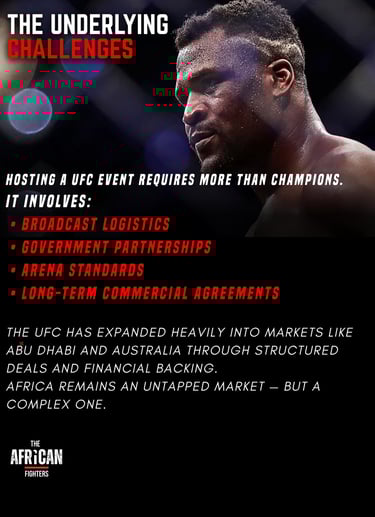
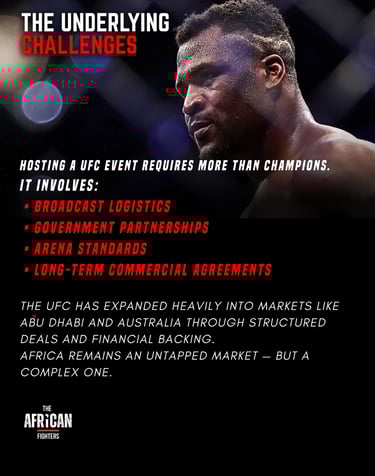
These comments highlight a central reality: hosting a UFC event involves global broadcast operations, technical production standards, security coordination, and long-term commercial partnerships. Without those systems fully aligned, even highly desirable markets can take years to finalize.
Senegal entered serious venue conversations
In 2023, Senegal emerged as a leading candidate after evaluation of Dakar Arena, which met many of the UFC’s operational requirements.
Lawrence Epstein said, “Senegal is top of the list based upon the information that our team has put together.”
Reference: BBC Sport Africa interview, 2023.
He also stated, “The next step is a site survey, evaluate the arena and all the infrastructure we need.”
Reference: BBC Sport Africa reporting on UFC expansion planning.
Epstein additionally emphasized internal urgency from leadership, saying, “Dana White has been very outspoken. He is very impatient.”
Reference: BBC Sport Africa interview.
These comments demonstrate that interest from the UFC has remained active, even as final execution has taken longer than fans expected.
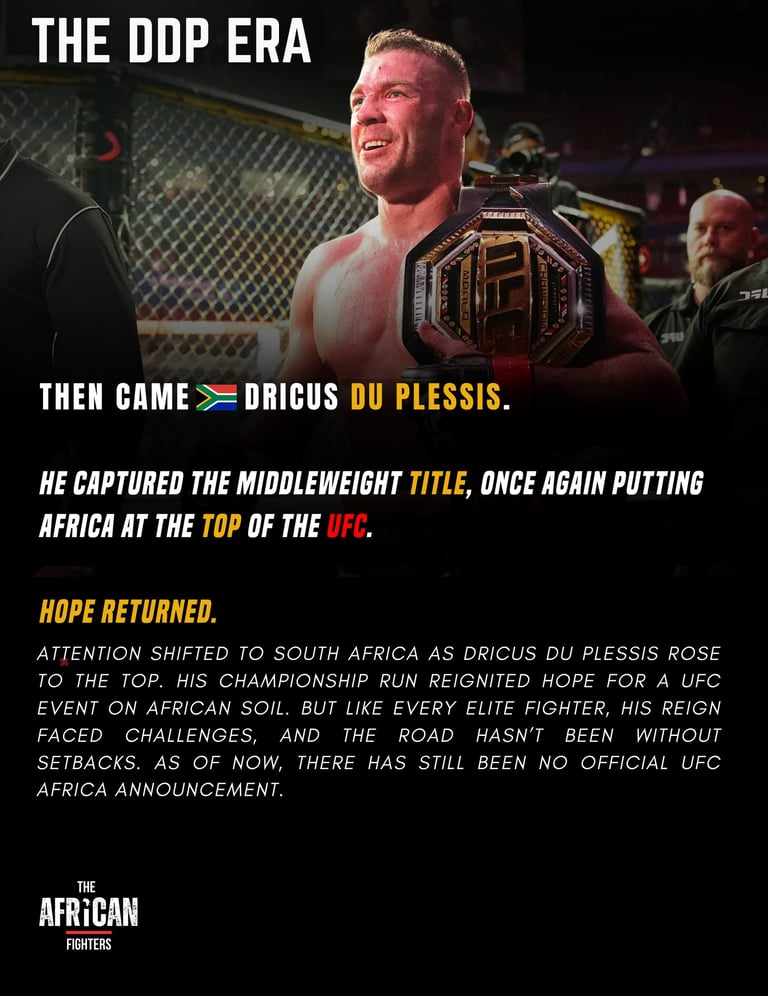
South Africa’s renewed relevance after Dricus du Plessis
South Africa returned to the spotlight when Dricus du Plessis captured the UFC middleweight title. The achievement received official recognition from national leadership, signaling the country’s growing presence in global MMA conversations.
The Minister of Sport, Arts and Culture congratulated du Plessis, stating, “I congratulate him for being the first South African to be crowned UFC Champion.”
Reference: Official Government of South Africa statement, Department of Sport, Arts and Culture.
While not a direct hosting announcement, the statement reflects increasing political recognition of MMA’s global importance and the potential economic value of major sporting events.
Nigeria’s cultural pull remains strong
Nigeria continues to be one of the most emotionally compelling potential hosts due to the success of fighters such as Usman and Adesanya, both of whom carry strong Nigerian identity ties. Nigeria’s Sports Ministry has repeatedly praised the achievements of Nigerian UFC champions, reinforcing the country’s interest in global MMA visibility.
Nigeria’s Sports Minister previously described Israel Adesanya’s success as an example of Nigerian excellence on the global stage.
Reference: Nigerian national sports ministry remarks reported by Punch Nigeria.
Despite this strong cultural momentum, infrastructure readiness and venue development planning continue to influence the timeline of any potential Nigerian-hosted event.
The reality behind the delays
The truth is that hosting a UFC event depends on far more than champions representing a region. Successful expansion into destinations such as Abu Dhabi and Australia was built on multi-year commercial agreements, government partnerships, broadcast guarantees, and infrastructure readiness.
Africa remains one of the fastest-growing MMA markets in the world, with passionate fan bases, rising athletes, and increasing global influence. However, aligning all the required logistical and financial components for a large-scale pay-per-view event takes time.
So what happened to UFC Africa?
Nothing and everything happened at the same time.
UFC leadership has consistently confirmed interest in bringing an event to the continent. Multiple African countries have entered hosting conversations. Arena assessments have been discussed publicly. Government recognition of MMA’s importance continues to grow. Yet the operational complexity of launching a new continental event at full scale has slowed the final announcement.
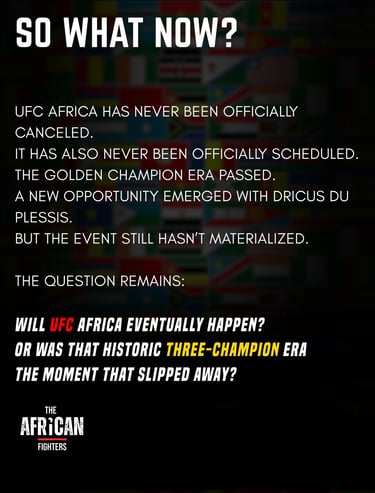
The golden championship era that once made the event feel imminent has passed, but the opportunity itself remains. As new African contenders rise and commercial partnerships evolve, the long-anticipated debut of UFC Africa remains less a question of possibility and more a question of timing.
The event has not disappeared. It is still in the process of becoming reality.